BY MILY MABE
SÃO PAULO, BRAZIL
2026
Japanese-Brazilian Cuisine:
between adaptation
and distortion.
The project is based on the analysis of the transformation of Japanese cuisine in Brazil influenced by mass consumption.
Starting from the idea that all cuisine is hybrid, the research questions through installations, interviews, and drawings, the limits of adaptation and translation between the preservation of memory and cultural identity and a process of distortion or cultural emptying.
The proposal critiques the distortion of Japanese cuisine in Brazil, which often goes through simplified and exoticized translations, reinforcing stereotypes and prejudices about the culture. At the same time, it encourages the new generation to reclaim techniques, ingredients, and ways of adapting the cuisine while respecting japanese-Brazilian memory and identity.
IMMIGRATION
ADAPTATION

Japanese immigration to Brazil officially began in 1908 and can be divided into two main phases. The first, between 1908 and 1941, was marked by the coffee cycle. The second, between 1952 and the 1970s, took place in the post-war period, during a time of economic and cultural expansion. Around 190,000 people arrived in Brazil during this first wave, forming rural communities, diversifying agriculture, and spreading across the countryside of São Paulo and northern Paraná.
This flow was interrupted in 1942 due to World War II and the breaking of diplomatic relations between Brazil and Japan. During this period, the Japanese population faced persecution, censorship, and deprivation of information and culture. In 1952, relations between the two countries resumed, immigration restarted, and the Nikkei community began to play a stronger role in Brazilian politics, industry, and commerce.
Agriculture was one of the main tools in building this legacy. Through it, the Japanese community transformed cultivation techniques, production chains, and eating habits, introducing vegetables, greens, and fruits that became part of the Brazilian table. This movement also helped improve food supply in major cities and the living conditions of producers.
When the first immigrants arrived in Brazil, many ingredients used in Japan did not exist here. Recipes had to adapt to Brazilian soil. Traditional Japanese cuisine has always sought to make the most of ingredients, avoid waste, and respect the original flavor of food. With little use of fat and heavy sauces, alongside fermented foods and attention to seasonality, it values lightness, balance, and diversity in its composition. Even so, more than the ingredients themselves, it was the techniques, combinations, and ways of serving that preserved the identity, memory, and spirit of the dishes. Miso paste made from chickpeas, tsukemono made with green papaya, chayote, and melon, dried sardines replacing bonito fish for dashi, mustard leaves used to wrap onigiri, corn-based soy sauce, carioca beans used for making azuki, cassava flour used to wrap dango, among others. For years, these adaptations remained within the intimate universe of first- and second-generation families.
In the 1950s, Bunkyo, Enkyo, and the Brazil-Japan Cultural Alliance became officially recognized as important Japanese-Brazilian institutions that strengthened cultural preservation, reception, and ties between Brazil and Japan. Bunkyo and the Kenjinkais became essential gathering spaces for immigrants and their families, bringing together different generations through monthly celebrations, cultural events, sports activities, and seasonal festivities. These gatherings function as spaces for coexistence and the preservation of collective memory. Undokais, karaoke events, matsuris, cultural performances, championships, bazaars, and community lunches all help preserve customs, accents, recipes, and emotional bonds between families.
During the “motiyoris” held at the kaikans*, each person brings a dish, and the table is formed collectively: futomaki, hossomaki, nishime, onigiri, pastel, risoles, potato salad, sausage, stew croquettes. This mixture is full of richness. Far from being gourmetized, it comes from the use of local ingredients, accessible products, and the need to satisfy a broad audience. The selection of dishes is guided by memory, comfort, and practicality.
*A kaikan is a Japanese-Brazilian community association that functions as a space for gathering, cultural preservation, and community connection.

HYBRIDIZATION
The very idea of food “purity” is complex. Brazilian cuisine, for example, was born from the encounter between Indigenous, African, and Portuguese influences. Food has always been directly connected to social movements, migration, and cultural exchange. Conceptually speaking, perhaps food purity no longer exists - everything is already hybrid. Diaspora is one of the main drivers of food transformation. Gohan with carioca beans is one example of this meeting between cuisines.
This process also happened in other countries. In Canada and the United States, the initial difficulty in accessing traditional Japanese ingredients, combined with resistance toward raw fish and nori, led to adaptations in recipes. Ingredients such as crab, fruit, and stronger sauces gained ground, while seaweed began to be placed inside sushi rolls to make it more acceptable to Western palates. In the United States, combinations such as cream cheese and fried rolls also emerged, marking the development of a more hybrid, popular, and fast-consumption-oriented Japanese cuisine.
In São Paulo, Americanized sushi became especially popular from the 1980s onward, particularly around Consolação Street (center), driven by the media and by the association of Japanese cuisine with a healthy and cosmopolitan lifestyle.

INDUSTRIALIZATION
URBANIZATION
Brazilian urbanization deeply transformed our relationship with food. Initially rooted in agricultural activities and later driven by post-war industrialization, cities began to impose an accelerated rhythm on eating habits. The street became a space of tensions and convergences, where local and foreign cultures mix through both formal and informal commerce.
With the intense flow of people, food formats designed for speed and convenience emerged, such as self-service, drive-through, delivery, and grab-and-go (it’s not surprising that these terms were adopted into the Brazilian popular vocabulary). The logic behind these services is to make people gain or lose time, depending on the perspective. Time is saved in preparation, consumption, and transportation, but lost in food quality, appreciation of the moment, and connection to a specific culture. These kitchens condense preparation processes, rely on pre-made formulas, and use ultra-processed ingredients. There is a clear proximity to the American way of life and the Fordist logic of massification, when food becomes pasteurized and, along with it, comes a kind of physical, mental, and social malnourishment.
Industrialization breaks with circular and sustainable economies while reinforcing economic, cultural, and food inequalities. While family farming and terroir respect the soil, climate, topography, and local culture, industrial agriculture seeks to dominate natural factors to maximize production and profit.
In a way, when consuming food from supermarkets and fast-food chains, people become disconnected not only from the source of their food but also from their own culture. We often do not know who produced it, how it was produced, or under what conditions. The accelerated pace of the cities and excessive consumption make our relationship with food more immediate, less social, less nutritious, and more superficial

MASSIFICATION
STATUS
DISTORTION
Within commercial Japanese cuisine in Brazil, it is possible to make a simple division into three categories: fast-food, traditional restaurants, and fine dining.
Fast-food kitchens use inexpensive ingredients as tools for sales and market adaptation. Many people want to eat Japanese food, but are not always familiar with more traditional flavors or able to afford specialized restaurants. Ingredients such as cream cheese, fruit, strong sauces, and fried elements help bring these dishes closer to the Brazilian palate, making the experience more accessible either in taste and price, especially because they rely less on ingredients considered premium or expensive. The question of value is directly connected to access and availability, also shaping how we develop our criteria for what we consider “good” Japanese food. Often, consumers accept certain preparations because they do not have enough references or repertoire for comparison.
There is a degree of learning involved in the conception of flavor, technique, and quality. At the same time, there are important cultural differences in the construction of taste itself. While traditional Japanese cuisine values delicacy, balance, seasonality, and subtlety, Brazilian food culture often leans toward excess, intensity, and abundance.
Traditional restaurants offer classic dishes adapted to local seasonality, such as stews, soups, grilled dishes, and raw preparations. However, some basic ingredients, such as Japanese rice itself, are expensive, which directly impacts the cost of the meal. Omakase restaurants, on the other hand, offer exclusive experiences, imported ingredients, and delicacies served in limited quantities.
There is a clear division between cost and volume on one side, and technique, quality, and exclusivity on the other. Salmon is one example of this. In many popular all-you-can-eat restaurants, around 80% of the fish served is farmed salmon from Chile. Its use is practical and inexpensive because it can be frozen and thawed without losing its color, often maintained by dyes present in the feed. The massive consumption of this fish also creates significant environmental impacts in Chile, as many salmon escape from farms and affect native species in the region. Even so, salmon is still associated with sophistication, despite not occupying such a central role in traditional Japanese cuisine.
In Japanese cuisine, the quality of fish does not necessarily depend on its origin, but on how it is handled. Fish must be fresh to be consumed raw. Other dishes, such as kakiage - very common at food fairs - have also had their composition modified to meet mass consumption demands, with more flour added to reduce costs, making them closer to a fried cracker than to tempura itself, where a greater variety of ingredients would normally be present.
When a food becomes widely consumed outside its original context, it stops functioning as a marker of otherness and becomes integrated into the everyday life of the dominant culture. In this process, its origins may be softened, reconfigured, or even erased. Society tends to recreate dishes according to its own cultural references. It is possible to say that Japanese cuisine in Brazil became popularized with different degrees of recipe preservation, whether technically or through adaptability of composition. As Sidney Mintz describes, food adaptation is inevitably a process of cultural translation. However, when this translation becomes disconnected from its original symbolic systems, it can result in distorted forms emptied of meaning.
“Mayonnaise is a very curious thing. In Japan, people are crazy about mayonnaise, some even put a bit of it on rice, with curry, or in the tuna filling used for onigiri. Every household has a tube of mayonnaise in the fridge. They even like cream cheese, but it’s worth remembering that half of the Japanese population, if not more, is lactose intolerant. So the consumption of cream cheese doesn’t even come close to mayonnaise.
I think mayonnaise has become incorporated into Japanese culinary culture, just like ketchup. Which, by the way, is also another curious thing, it’s used in cooking almost like tomato sauce or seasoning. It’s in omuraisu rice, in ‘Naporitan’ spaghetti, and so on. Especially in the case of ketchup, I don’t see it as Americanization, because sweet and sour are flavors very connected to Japanese cuisine. Besides, ketchup actually originated in China, so it’s kind of something that traveled around the world and came back to the same place.”
MARISA ONO
“I always ate mochi with sugar and soy sauce. Once, I went to Galinha’s house, he’s from Okinawa, and they were making mochi. When it was time to eat, instead of sugar and soy sauce, they served it with natto. I was surprised. Later, I realized that if you grate yamaimo with natto and eat it with mochi, it’s also really delicious. And back then, natto used to be sold kind of like pamonha, you know the Brazilian corn dish? It came tied up in little bags, handmade.
One thing I loved as a child was going to an aunt’s house who had a rangpur lime tree. She would make juice from it, then add a spoonful of baking soda, and it would turn into something like soda.
Do you know shiruko? It’s a sweet anko soup with little mochi balls. My batian, when she made it for me, used to make an adapted version with just flour and water. She would shape the balls with a spoon and drop them into hot water to cook, kind of like gnocchi. Dango jiru, a term from Kumamoto it refers to something without a perfect or defined shape.”
YUGO MABE
“When you go to a Japanese all-you-can-eat restaurant in Brazil, the first dish is salmon carpaccio marinated in Normandy butter. Then comes ceviche, which is a Peruvian dish, then tartare, which is French, then the California roll and hot roll, which are American, then hot temaki, also an American-style dish… A sequence of dishes that are not actually Japanese, and that’s where part of the distortion comes in.
Someone who is used to eating at all-you-can-eat restaurants has often never experienced traditional Japanese food, only low-quality salmon and tuna. It’s time to level up: you have to go to a traditional restaurant and try fish other than salmon.”
CARLOS SUZUKI
“The concept of Japanese-Brazilian cuisine proposes a distinction between the cuisine that emerged within immigrant communities and the Japanese-Brazilian cuisine created by Brazilians.
The obachan’s food - domestic, homemade, family cooking, was stigmatized because obachans were economically and socially very humble. The obachan would hide her cooking inside the home: ‘I made it my own way, it’s nothing special.’ But there was an incredible culinary knowledge there. This sense of shame was passed on to the second generation, and this cuisine was not shared with friends, becoming something restricted to a very intimate universe. In the third generation, a kind of recovery begins take place. Out of curiosity, people start to realize that there is something hidden within family food. This recovery is urgent. The research is urgent.”
JO TAKAHASHI
“‘I would never accept going to a restaurant that doesn’t have hot rolls.’ I’ve heard many comments like this in the restaurants where I worked, from customers saying that hot rolls are traditional. For us, that makes no sense at all, right? But from their perspective, hot rolls are traditional, and serving sushi that isn’t torched and without foie gras is considered fusion — when, in reality, it’s completely the opposite...
Uramaki itself is something that doesn’t exist in traditional Japanese cuisine. By inverting the roll and placing the seaweed inside, you lose all the crunch and texture. It’s an Americanized adaptation that eventually arrived in Brazil...
Taste is relative: what fascinates me may not fascinate someone else. Gastronomy is very broad. If you think about Brazil as a whole, perhaps the ultra-traditional wouldn’t survive. So, in that sense, maybe we lose a bit of the culture, but at the same time, it contributes by creating jobs for people.”
EDSON YAMASHITA
Excerpts from interviews conducted during the research with second and third-generation Japanese Brazilians.
ALL YOU CAN EAT
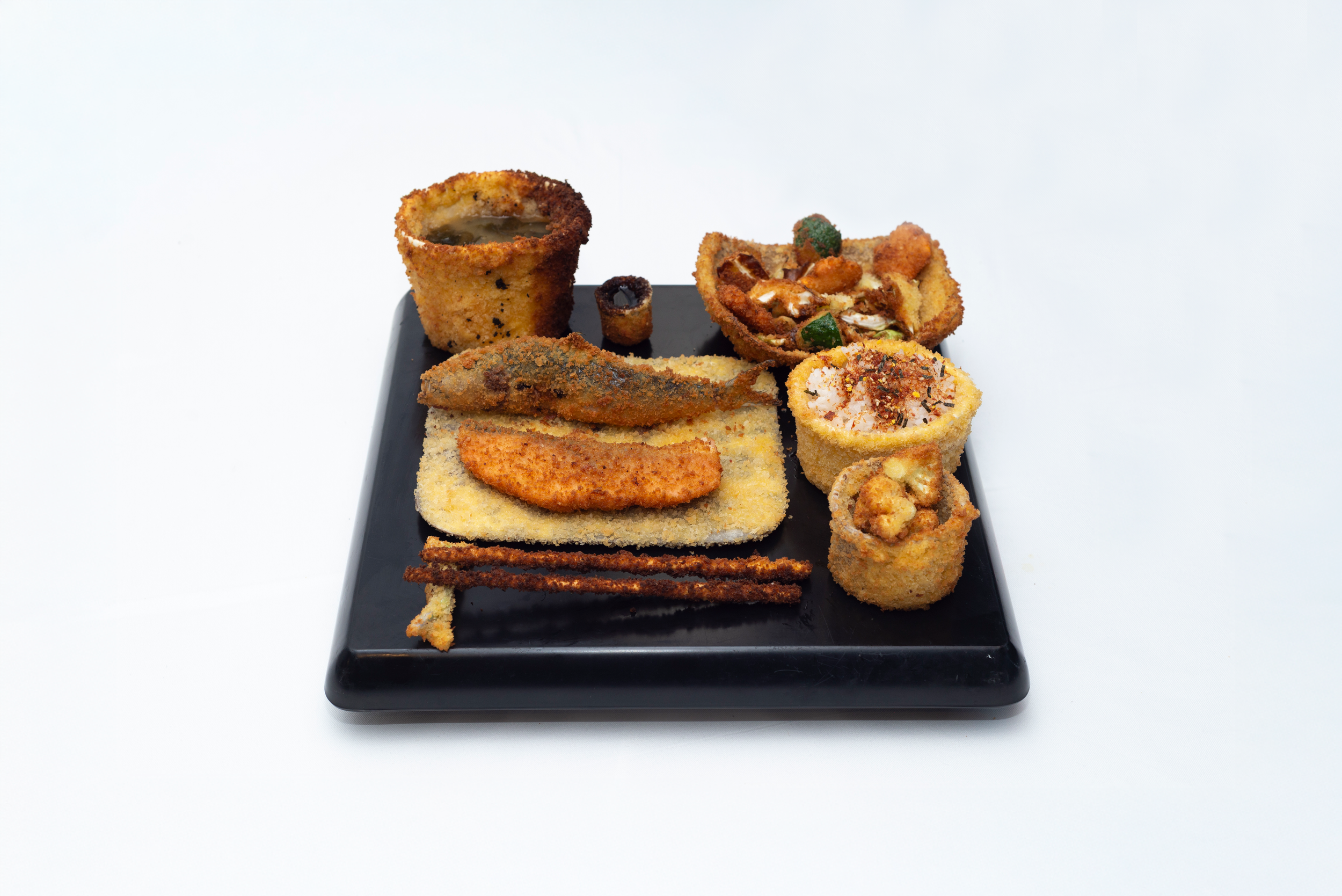
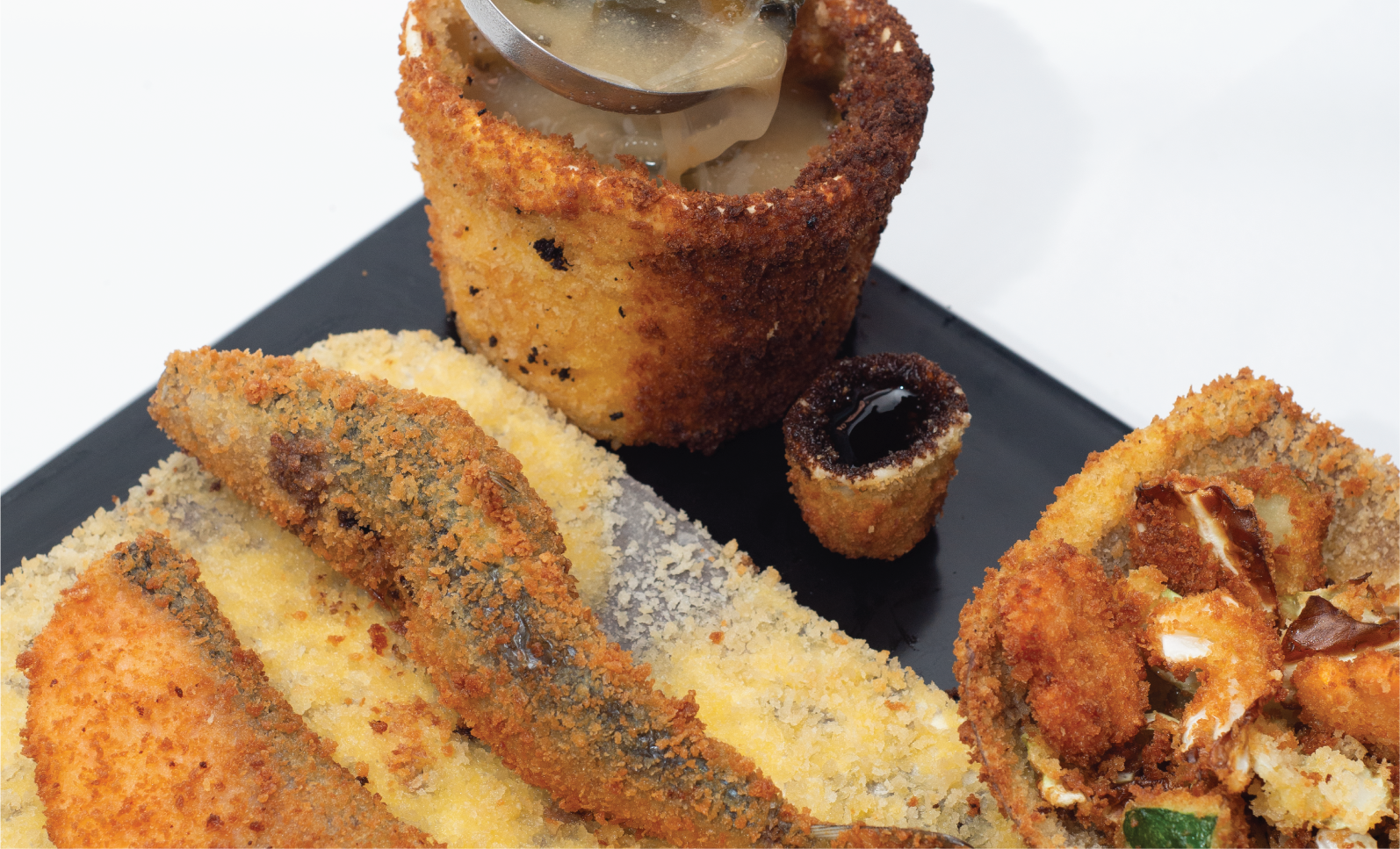
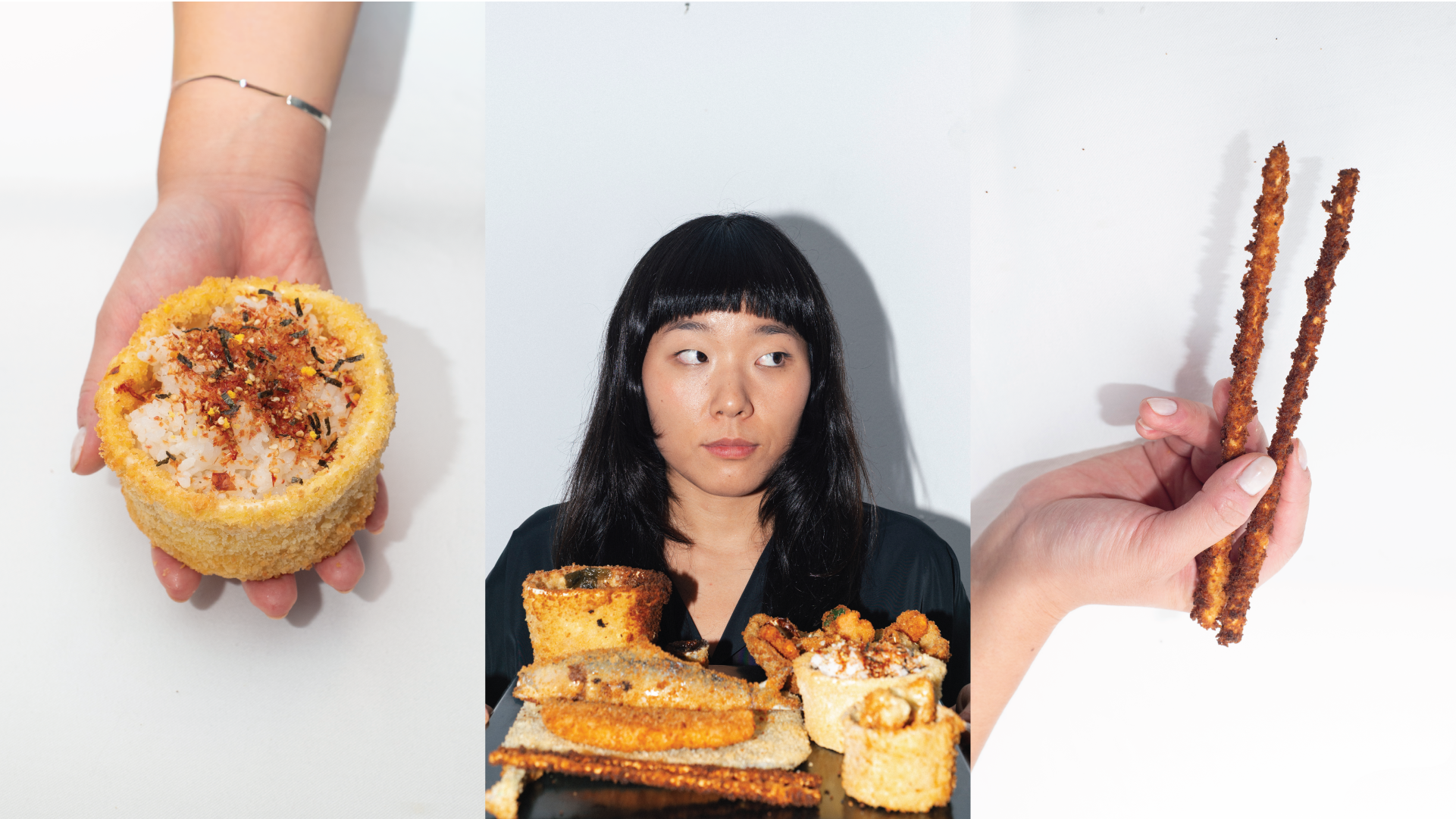
The installation pushes consumption to an absurd level, where food and vessels blend together, making it difficult to distinguish what is and isn’t edible. By flattening everything into the same fried surface, the original reference of each item is lost, along with its flavor, color, texture, and uniqueness.
The dish chosen to compose this table is a teishoku, very popular in Japan and commonly found in traditional Japanese-Brazilian restaurants. It consists of gohan, miso soup, tsukemono, salad, and a main grilled dish, a balanced and nutritious meal that represents the essence of Japanese cuisine beyond sushi and sashimi.
what is the limit
of adaptation?
ACKNOWLEDGEMENTS
Francesca Zampollo
FONDO School
Nicole Vindel
Yugo Mabe
Suza Mabe
Stefano Minelli
Marisa Ono
Jo Takahashi
Edson Yamashita
Carlos Suzuki
Fábio Ayrosa
Julia Poá
Victoria Pimentel
This is a food design project
by Mily Mabe